
“Does anyone know of any effective interventions for children who cannot decode?” Here is Carl Pattison’s response to this common question:
Have you seen the following:
- A child struggling to learn to blend and stuck on wordless books?
- Phonics knowledge known one day but then forgotten the next?
- A widening gap between the phonics one child knows compared to his peers?
- A child who has started the phonics journey but whose progress has significantly slowed or stopped?
- Are additional phonics lessons or phonics interventions simply not working?
- Staff feeling like there must be an alternative to phonics.
I have, and the many people I work with in schools have, as these are common challenges parents and schools can face.
In England, there’s an understanding that phonics is the most efficient route to empowering children to decode (and encode) the written word. Most professionals accept this but can often grapple with the concept of ‘phonics as a route to decoding’ when they are faced with children who are struggling to move forward with their reading. Take the following post on an English leaders group as an example:
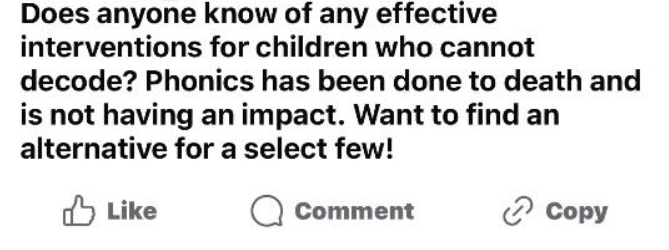
Simply put, the practitioner is searching for another way. They care so much about the children doing well, so it is natural to keep searching for something that will work. It is what parents want from the amazing people in school: a relentless drive to help their children. ‘Phonics has been done to death,’ is also such a fascinating part of the message. Like I suggested, they know phonics is the route to decoding, but it has not yet proved useful. However, they are dedicated and resilient practitioners, so they will continue to work with phonics. In many cases they persist with phonics until the child moves through the year groups and is still not reading well. At that point, two things tend to happen from my experience:
- The school starts to look at the child and identify that there is a problem with the child. E.g., a learning need.
- Phonics does not work for this child, so we need to find another way.
Both of these reflections are totally understandable, and there will be experts out there who will say that these are both plausible and accurate solutions. From experience and numerous discussions with schools, there have been various times when ‘experts’ have offered 1. or 2. to
the school as to help with certain children. Therefore, it is understandable that schools and practitioners form these judgements as they will value the opinion of experts.
At this point in my post, I’d like you to reflect on the following:
-Are you happy with the solutions above, and are all children in your school thriving with reading?
If the answer is yes, you might want to stop reading now and keep doing what you are doing. If the answer to the first half and/or second part of the sentence is no, you might find the post thought-provoking, challenging, and hopefully useful.
Let’s go…
Why do we ‘label’ children and start to think that there must be a problem with the child when we feel phonics has not worked? Well, there is some truth in this approach: Children are all unique, and the challenges that they face when learning to read can vary. You only have to consider Nancy Young’s ‘Ladder of Reading and Writing’ to understand this. Learning to read can be a simple journey for some; however, for various reasons, it can be a very difficult and challenging time for lots.
Here comes a more contentious point: As practitioners, we are relentless in our journey to help children, but when it has not worked, there can be a natural response to label the child, as this moves the spotlight from us to them. Essentially, we are saying, It isn’t me; it’s them. Instead of seeking extra guidance, looking at our own practice, and zooming in on what the specific challenge is, we add the label, which takes away the pressure and challenge we face. Learning to read and teaching reading is not an easy process for all. Therefore, simple interventions and simple approaches straight from the phonics program manual are unlikely to work for all children. Simply put, unlocking the code for some children is not an easy process.
Let’s consider the other point about looking for another way. Essentially, it’s the same as adding a label in many ways. This way hasn’t worked, so there must be another. It isn’t me; it’s the way we teach phonics, or phonics itself, that is the problem. As I have said, this is totally understandable given the guidance we receive, the social media posts we see, etc. My key point here is that the reflections are totally understandable, but we have to think a different way:
We need to say, ‘Phonics hasn’t worked yet,’ then consider the following to help diagnose why:
- Does my approach to assessment focus in on what they can and cannot do? Is it precise enough?
- Am I skilled in analysing the assessment data, or would I benefit from speaking with an expert about this?
- Has it worked at all, and what part isn’t working? For example, they can read CVCs but now struggle with adjacent consonants. E.g., sn
- How effective has our support been? (I meet need to seek expert advice to help analyse this in my school.)
- Are the adults that work with the child(ren) true expert reading teachers with extensive subject knowledge?
- What particular need(s) make learning to read challenging? Have we considered this and made suitable adaptations so that the child can still access high-quality phonics interventions? One of my favourite resources to support this is the wonderful Ann Sullivan when she works with a non-verbal child. Check it out here.
If we shine the lens on ourselves and reflect on these questions, we might arrive at a few areas that simply aren’t good enough, and that is fine (as long as you are willing to do something about them).
Finding the solution(s)
Let’s look at how I support schools to be successful when meeting this challenge. Firstly, I have simplified the three key areas that need to be in place if schools are going to be successful in teaching all children to read.
- Knowing the reading journey
- High expectations
- Knowledge of specific needs and suitable adaptations.
Knowing the reading journey
Having taught my own children to read, worked in education for over twenty years, and worked with a vast array of schools as a literacy advisor, I have been able to apply my subject knowledge of reading in a variety of contexts with an extensive number of children (I have also made mistakes during this journey!). As a parent and more recently, an advisor, I have been able to closely focus in on the parts of the reading journey that children can find tricky. Here is a summary of my thoughts and observations about a phonics journey for reading:
- Books need to be seen as something fun and worthwhile engaging with.
- We need to tune the children into the idea that there are phonemes and they come together to make a word. E.g., “What’s my word? /o/ /n/.”
- Start to learn the first set of grapheme-phoneme correspondences (GPCs), which are usually s, a, t, p, i, and n.
- Recognise graphemes and the corresponding phonemes. Cat = /k/ /a/ /t/.
- Blend those phonemes to discern the word (this might also involve accessing vocabulary comprehension). I find that children with larger vocabulary knowledge generally discern the word more easily if it is a known word.
- Continue to increase the number of GPCs they know and CVCs they can read.
- Learn exception words that have parts in them that do not match the GPCs they know. E.g., said
- Begin to add s to the end of words and notice that sometimes it’s /s/ and other times it can be /z/. E.g., hits or bags. ‘ed’ endings are a similar challenge later down the line as they can represent three different phonemes too!
- Read words with more than one syllable. E.g., zigzag.
- Reading words with adjacent consonants at the start, end, or both. E.g., clap, lamp, clamp.
- Learning digraphs (th, sh, ay, etc.) and trigraphs (igh, air, ear, etc.) GPCs. Consonant digraphs (sh, th, ng, etc.) then vowel digraphs (ee, ay, etc.)
- Being able to spot digraphs in words and say the corresponding phoneme accurately instead of two separate phonemes. Then read the word correctly. g. ch as /ch/ not /c/ and /h/
- Knowing and reading words with split vowel digraphs in them. E.g., an a_e in cake.
- Reading words with more than two syllables.
- Learning the complex code and understanding that a given grapheme can represent different phonemes. E.g., apple, table, many, etc.
As I said, this is a summary of the journey, but it does identify the steps that might present as a challenge. For example, for children that started the phonics journey but progress has slowed or halted, there will be a step above that is the challenge they need support with.
Obviously, there are many things involved, but this 15-step journey might help you really focus in on the part of the journey that needs to be overcome. If practitioners have this knowledge of the journey, they are better placed to use assessment knowledge and observations to truly understand what the challenge is. When you know the challenge, you are better placed to support the child to overcome it.
It is also worth noting that schools are faced with an array of phonics programs that meet the phonics journey/challenge in different ways (some more successfully than others). Personally, I am a firm believer in using paper-based materials and high-quality resources. Simple flashcard only programs can often result in too many children falling through the net, as it’s often a ‘done to’ model with various limitations. With paper-based materials, children are challenged to apply their knowledge and as they are using a content-rich resource, practitioners have instant access to what the child can and cannot do.
High expectations
This is a little more contentious, as we are unlikely to find anyone working in schools that doesn’t believe they have high expectations. From experience, it is the actions and beliefs that might identify that expectations might not be as high as they should be. For example, a child might be removed from a certain part of the lesson as it is ‘too challenging’ for them. This might be the case, but have we exhausted all possible options to help them engage in that content? Also, I do believe that labelling children, as mentioned earlier, can be a sign of lowering expectations. Another common example I come across is children trapped on the first set of decodable reading books within a phonics program. Practitioners know the child struggles, so they accept that they will continue to read the ‘easy’ books. The alternative is to think about assessment data and the reading journey, then address the gaps in skills and knowledge so they can move onto the next book(s). Another version of this is children removed from the main group and repeatedly getting taught ‘s, a, t, p, i, n’. This might take place throughout reception and into year one. I should really put a quote in here about “…doing the same thing over and over but expecting…” However, there is a counterargument to this in phonics, which I’ll explore in the next paragraph.
In summary, the key reflection for practitioners is to consider the actions they take and the beliefs they hold. Do they truly demonstrate high expectations?
Knowledge of specific needs and suitable adaptations
I’ll start by picking up on my point about doing the same thing over and over but expecting a different outcome. In certain contexts, this is crucial when helping all children become competent readers. Take the Facebook post I shared earlier: That way of teaching phonics clearly is not working, so repeating that same approach is unlikely to work. What I mean by that is the idea of repeating ‘their way’ of teaching phonics. It might be that the ‘way’ is correct, but the problem is with implementation. It could be as simple as not implementing activities with full fidelity to their program. In that case, repeatedly doing it like this is unlikely to lead to success. With the best intentions, I find that practitioners can tweak activities, and before you know it, it does not follow expert guidance and is unlikely to lead to success.
In contrast to this, there are times when we need to stick at it and repeat activities. I refer to these as ‘reps’. Some children simply need more ’reps’ if they are to secure information in long-term memory and move towards automaticity. Let us look at an example where this was the case.
Recently, a school asked me to work with a year one child who was not progressing with phonics. They thought he had some ‘cognitive learning’ issues due to the limited progress made recently. Here’s how it went:
He read his decodable reading book to me and could sound and blend ‘sit, sat, and pat.’ If he came across ‘pit pit,’ he would sound and blend the first word but not need to do this for the second as he simply said the word. E.g., “/p/ /i/ /t/ pit, pit.” He read ‘it’ and ‘in’ with automaticity.
-I then took some flashcards and made ‘snap.’. He could not read it. He said “nap” then tried “sap,” which is typical. I did a short intervention that led to him being able to read ‘snap.’
-Later that day, I worked with him again to teach an unknown GPC. Assessment showed he did not know ‘j’. During the activity, he could say it clearly, shape it, and say it, and shape it, then say it. In the pack of flashcards, he could say a different GPC,was here that we found the challenge and what we needed to focus on. then say /j/ when the j appeared on the next card. However, he could not say /j/ for j if it appeared after two other GPCs. Instead, he would say /i/ or nothing as he could not remember it. It was here that we found the challenge and what we needed to focus on.
- He demonstrated that he was able to say four phonemes and blend them to read snap.
- He was able to learn GPCs and blend them to read CVCs.
- He has some words that he can read with automaticity.
- He was able to do a task whilst saying the corresponding phoneme.
- Importantly, he demonstrated that he can do phonics.
The challenge? Knowing j as /j/. Interestingly, j looks pretty similar to i, and he was confusing them. Also, there was the challenge of saying two phonemes then the /j/. Both of these can be challenges for children with dyslexia: Working memory and verbal memory (holding the /j/) but also visual memory. The j looking like the i he knows. I shared this with the school, and interestingly, both of his older siblings had a dyslexia diagnosis. It would be easy to say that he knows the GPC based on his ability to recognise it in the first part of the activity; however, it has not been truly learnt given the challenge I identified.
Going back to what I said earlier, I did not want this to become a label (I’m not a professional who can diagnose dyslexia for a start!). Instead, my advice was to focus on repetition of the activity I modelled. Basically, increasing the reps of saying /j/ when he comes across it in the pack of flashcards. Firstly, after a different GPC, then after two. If this is not successful, the next step is to bring in a multisensory approach. When the j appears, we would get him to shape it and say it as he is successful with this. We wouldn’t move away from phonics or give him a label; we will simply focus on the need and decrease the reps while considering any adaptations that might be needed. Once he grasps it, we’ll then offer lots of opportunities to apply it.
If I were to return to the school, I would be interested to see how he learns another GPC instead of j. Maybe one that looks quite different from the ones he already knows. I wonder if the same challenges would be evident.
Understanding the needs of the child needs a good knowledge of reading and some knowledge about special educational needs—not the labels but the particular challenges that can be evident with particular diagnoses or SEND. For some needs, this is really obvious. For example, for a non-verbal child, we might need to focus on enabling them to communicate their understanding. They can’t say a phoneme, so we might need to give them options so they can point. Unfortunately, this same approach might not work for all non-verbal children, as they might have other challenges with the reading journey.
In summary
That final point helps me to summarise my post: Teaching reading is difficult, and so is learning to read for some children. We simply need to believe we can do it, but if we can’t, we must seek expert guidance and support for the children we support. That will help us identify where the challenges are and what we can do about them to ensure they access phonics successfully and continue on the journey to becoming a successful reader.